
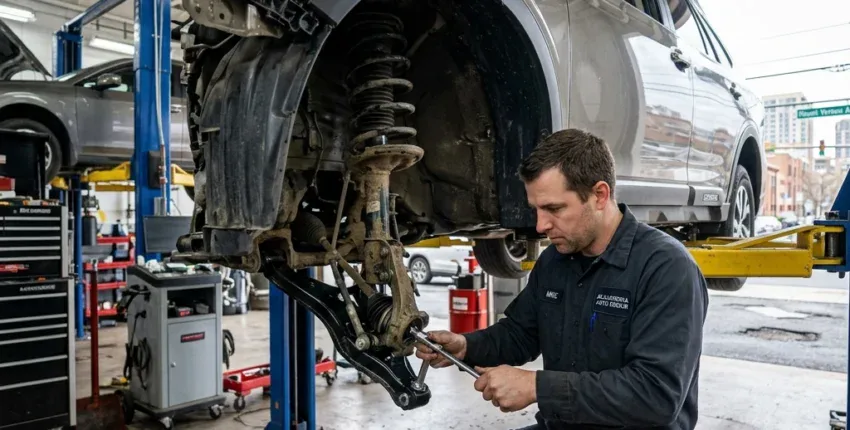
Alexandria winters are tough on our roads. Between the freezing temperatures and the constant snowplows, our streets often look like a lunar landscape by the time April rolls around. If you’ve spent any time driving down Telegraph Road or navigating the historic streets of Old Town, you know that pothole season isn’t just a nuisance: it is a direct assault on your vehicle’s health.
Your suspension system is the only thing standing between you and the bone-jarring impact of a deep crater. However, many drivers in Northern Virginia make critical errors when it comes to maintaining this system. Neglecting your suspension doesn’t just make your ride uncomfortable; it compromises your safety and drains your wallet.
In this guide, we will explain the seven most common mistakes drivers make with suspension repair in Alexandria, VA and, more importantly, how you can fix them to keep your car running smoothly.
1. Treating Potholes as “Mild Suggestions”
The biggest mistake starts before you even reach the shop. Many drivers assume that if their car didn’t lose a wheel immediately after hitting a pothole, everything is fine. This is a dangerous assumption.
The Component: Shocks and Struts
Your shocks and struts are the heavy lifters of your suspension. Their function is simple but vital: they dampen the energy from bumps and keep your tires in contact with the road. They act like a cushion for your car’s frame.
Signs of Trouble
- A “bouncy” feeling after hitting a bump.
- Fluid leaking down the side of the shock absorber.
- The front of the car “nose-diving” when you hit the brakes.
- Cupped wear patterns on your tires.
The Negative Impact of Neglect
Ignoring a damaged shock means your tires aren’t making consistent contact with the asphalt. This leads to significant increases in stopping distances. It also puts extra stress on your braking system, meaning a small suspension issue can quickly turn into a more expensive brake job.
The Fix: If you hit a significant pothole in Alexandria, don’t wait for a breakdown. Bring your vehicle in for a visual inspection immediately.

2. Replacing Only One Side at a Time
When a technician tells you that your front-left strut is blown, your first instinct might be to save money by only replacing that one part. This is a major mistake that leads to an unbalanced vehicle.
The Component: Suspension Pairs
Suspension components are designed to work in tandem across an axle. Think of them like a pair of running shoes; you wouldn’t replace just the left shoe and expect to run a marathon comfortably.
Signs of Trouble
- The car leans to one side when parked.
- Uneven handling when turning left versus turning right.
- A “loose” feeling on one side of the car.
The Negative Impact of Neglect
Installing a brand-new, stiff strut on one side while leaving a worn, soft strut on the other creates an unpredictable ride. This imbalance can cause your electronic stability control to trigger unnecessarily. It also causes the new part to wear out faster because it is doing more than its fair share of the work.
The Fix: Always replace shocks and struts in pairs (both fronts or both rears). This ensures your vehicle remains level and handles predictably in emergency situations.
3. Skipping the Wheel Alignment Post-Repair
Many drivers think that once the new parts are bolted on, the job is done. However, suspension repair and wheel alignment go hand-in-hand. You cannot effectively have one without the other.
The Component: Steering Geometry
Wheel alignment refers to the angles at which your tires contact the road. Even a tiny 2mm deviation can cause crucial handling issues.
Signs of Trouble
- Your steering wheel is off-center when driving straight.
- The car “pulls” to the left or right.
- Squealing tires when taking slow turns.
The Negative Impact of Neglect
If you skip an alignment after a suspension repair, you are essentially throwing money away. Misaligned wheels will “scrub” against the road, destroying a set of expensive tires in just a few hundred miles. It also places unnecessary strain on your new suspension joints.
The Fix: Ensure your service includes a professional alignment. At Telegraph Auto Care, we use advanced automotive diagnostics to ensure your vehicle is perfectly squared away before it leaves the bay.

4. Ignoring the “Small” Parts: Bushings and Ball Joints
While shocks and struts get all the glory, your suspension is held together by dozens of smaller components. Pothole season is particularly cruel to rubber bushings and metal ball joints.
The Component: Ball Joints and Bushings
Ball joints are the pivot points between your wheels and the rest of the suspension. Bushings are the rubber cushions that prevent metal-on-metal contact. They are the “cartilage” of your car’s joints.
Signs of Trouble
- A loud “clunk” or “pop” when driving over a bump or turning the wheel.
- A creaking sound that reminds you of an old wooden floor.
- Vibrations felt through the steering wheel.
The Negative Impact of Neglect
Neglecting a failing ball joint is dangerous. If a ball joint fails completely, the wheel can actually collapse outward, detached from the steering system. This is a catastrophic failure that usually happens while the vehicle is in motion.
The Fix: Ask your mechanic to check the “play” in your joints during every oil change. Replacing a $50 bushing now prevents a $1,000 repair later.
5. Attempting Complex DIY Without the Right Tools
We love a hands-on car owner, but modern suspension systems are under immense pressure, literally. Attempting to swap out coil springs or struts in your driveway without professional-grade spring compressors is a recipe for disaster.
The Component: Coil Springs
These heavy-duty metal coils support the entire weight of your vehicle. They store a massive amount of kinetic energy.
Signs of Trouble
- The car sits lower than usual (sagging).
- Visible cracks or rust on the spring coils.
- Harsh “bottoming out” on small bumps.
The Negative Impact of Neglect
Aside from the physical danger to the person doing the repair, DIY mistakes often lead to stripped bolts or improperly seated components. An incorrectly installed strut can damage your engine bay or steering rack, leading to even higher costs.
The Fix: Know your limits. For simple things like checking tire pressure, go for it. For anything involving pressurized springs or complex geometry, trust a trusted car mechanic shop.

6. Overloading the Vehicle After “Soft” Damage
After hitting a few potholes, your suspension might be “soft.” This means the internal valves in your shocks are worn out, even if they aren’t leaking yet. A common mistake Alexandria residents make is loading up the SUV for a trip to the hardware store or a weekend getaway while the suspension is weak.
The Function: Load Bearing
Your suspension isn’t just for comfort; it manages the Gross Vehicle Weight Rating (GVWR). It ensures the car stays level even when you have passengers and cargo.
Signs of Trouble
- The rear of the car squats significantly with just a little weight.
- The headlights point toward the trees instead of the road at night.
- Frequent bottoming out on the highway.
The Negative Impact of Neglect
Overloading a compromised suspension can snap a weakened coil spring or blow out a tired shock. It also makes the vehicle incredibly difficult to steer, especially at highway speeds on I-495.
The Fix: Check your owner’s manual for weight limits and be mindful of how your car sits when loaded. If it sags, it’s time for an inspection.
7. Waiting for a Total Breakdown
The “if it ain’t broke, don’t fix it” mentality is the most expensive way to own a car. Suspension issues are progressive. They never stay small; they only get bigger and more expensive.
The Component: The Entire Chassis System
Your suspension is part of a delicate ecosystem that includes tires, brakes, and the transmission system.
Signs of Trouble
- Increased road noise.
- A “floaty” feeling at high speeds.
- Any change in how the car feels after hitting a pothole.
The Negative Impact of Neglect
Waiting until a part snaps means you aren’t just paying for the repair; you are paying for a tow truck, potentially a rental car, and the stress of a breakdown. Proactive maintenance is essential for your safety and your bank account.
The Fix: Schedule a “Pothole Season Recovery” check-up. A quick inspection can identify minor tears in CV boots or early wear in struts before they become emergencies.

Keep Your Ride Smooth in Alexandria
Don’t let the rough roads of Alexandria dictate how your car drives. Your suspension is vital to your vehicle’s performance, safety, and longevity. By avoiding these seven common mistakes, you ensure a smoother ride and significant savings over the life of your vehicle.
Are you hearing a mystery clunk? Is your car pulling to the side after hitting that crater on Duke Street? Don’t wait for the problem to get worse.
Visit Telegraph Auto Care today. Our team of experts is ready to perform a comprehensive suspension audit to get you back on the road with confidence.