
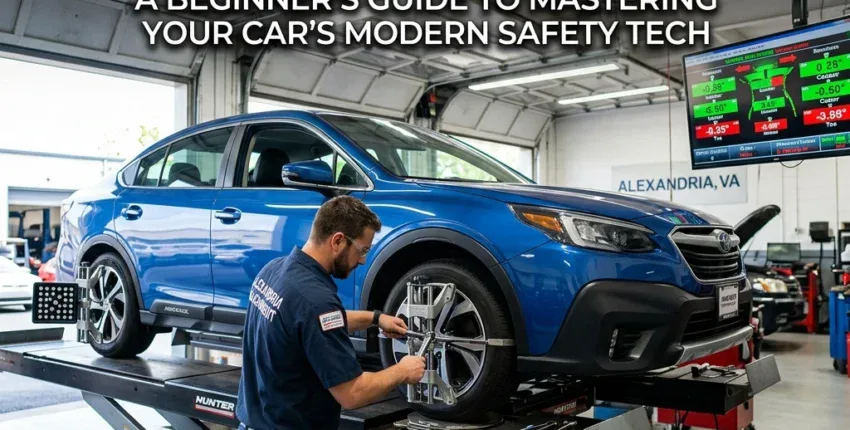
Driving through Alexandria, VA, requires a lot from your vehicle. Between the tight turns in Old Town and the high-speed merges on I-395, your car needs to be precise. One of the most vital yet misunderstood maintenance tasks is wheel alignment.
In this guide, we will explain why wheel alignment is no longer just about tires. It is now a crucial part of your car’s modern safety tech system. Let’s dive into the details of keeping your vehicle straight, true, and safe.
What Exactly is Wheel Alignment?
Wheel alignment is like the foundation of your home. If the foundation is crooked, everything else in the house starts to crack. In your car, alignment refers to the adjustment of the vehicle’s suspension components. It is not an adjustment of the tires themselves.
Modern vehicles are complex. They rely on precise geometry to move efficiently. When your wheels are aligned, they point in exactly the direction the manufacturer intended. This ensures your tires make even contact with the Virginia roads.

The “Big Three” Alignment Angles
To understand alignment, you need to know the three main angles technicians measure. Each one plays a specific role in how your car handles and how your tires wear.
1. Camber: The Vertical Tilt
The camber angle is like the way you tilt your feet inward or outward when you stand. It is the inward or outward angle of the tire when viewed from the front of the car.
- Signs of Trouble: Your car pulls to one side constantly. You notice the “shoulders” of your tires are wearing down much faster than the rest of the tread.
- The Negative Impact: Ignoring camber issues leads to rapid tire failure. It also reduces your grip during cornering, which is dangerous on wet Alexandria streets.
2. Toe: The Directional Angle
Toe means the direction your tires are pointing relative to each other. It is best visualized by looking down at your own feet. If you point your toes toward each other, that is “toe-in.” If you point them away, that is “toe-out.”
- Signs of Trouble: You see a “sawtooth” wear pattern on the tire tread. The steering wheel might feel loose or unresponsive.
- The Negative Impact: Incorrect toe settings “scrub” the rubber off your tires. This significantly reduces fuel economy and ruins a set of tires in just a few thousand miles.
3. Caster: The Steering Pivot
Caster is like the front forks on a bicycle. It is the angle of your steering axis when viewed from the side of the vehicle. It helps your steering wheel return to the center after a turn.
- Signs of Trouble: The steering wheel is hard to turn. The car feels “darty” or unstable at high speeds on the George Washington Memorial Parkway.
- The Negative Impact: Poor caster makes the vehicle physically exhausting to drive. It reduces your ability to maintain a straight line, increasing the risk of an accident.

Alignment and Modern Safety Technology (ADAS)
This is where things get interesting for modern car owners. Most vehicles built in the last decade feature Advanced Driver Assistance Systems (ADAS). These include lane-keep assist, automatic emergency braking, and adaptive cruise control.
The Steering Angle Sensor (SAS)
The Steering Angle Sensor is like your car’s digital inner ear. It tells the car’s computer exactly where you are pointing the steering wheel. This system is essential for modern vehicle safety.
- Signs of Trouble: Your “Lane Departure Warning” light flashes for no reason. The car tries to “correct” your steering even when you are in the center of the lane.
- The Negative Impact: If your physical wheels are misaligned but your sensor thinks they are straight, the safety tech fails. The car may apply the brakes or pull the steering wheel incorrectly. This makes your safety features a liability rather than a help.
Calibration is Crucial
In the past, a mechanic just adjusted a few bolts. Today, a wheel alignment in Alexandria, VA, often requires a digital reset. We must tell the car’s computer that the “new” straight ahead is the correct one. Linking your standard maintenance to these digital calibrations is vital for your safety.

Why Alexandria Roads Are Tough on Your Alignment
We all know the struggle of pothole season in Northern Virginia. Even a single encounter with a deep pothole on Duke Street can knock your suspension out of spec.
Potholes and Curbs
A pothole impact is like a sudden punch to your car’s joints. It can bend a tie rod or shift a control arm instantly. Even if the car “feels” okay, the angles are often slightly off.
- Signs of Trouble: A crooked steering wheel while driving straight. A sudden vibration that wasn’t there before.
- The Negative Impact: Small misalignments grow into big repairs. What starts as a $100 alignment check can turn into a $2,000 suspension and transmission repair if left unchecked.
Frequent Stop-and-Go Traffic
The constant braking and accelerating on I-395 puts repetitive stress on your bushings. Over time, these parts settle and shift. This gradually moves your wheels out of their ideal positions.

The Relatable Benefits of Proper Alignment
Why should you care about your alignment today? It comes down to your wallet and your peace of mind.
1. Significant Cost Savings
Tires are expensive. A full set for a modern SUV can easily cost $800 to $1,200. Proper alignment ensures those tires last for their full 50,000-mile rating. Without it, you might be replacing them at 20,000 miles. You are effectively throwing money out the window.
2. Better Fuel Efficiency
When your wheels are misaligned, they fight each other. One wheel wants to go left while the other wants to go right. This creates “drag.” Your engine has to work harder to push the car forward. Keeping things straight means less trips to the gas station.
3. Essential Safety
Safety is the most important factor. A well-aligned car handles predictably. In an emergency maneuver to avoid a deer or a distracted driver, you need your car to react exactly how you expect. Proper alignment provides that stability.
When Should You Visit Telegraph Auto Care?
You do not need to wait for a problem to occur. Being proactive is the key to mastering your car’s health. We recommend an alignment check at least once a year or every 12,000 miles.
You should also book an appointment if:
- You just bought a new set of tires.
- You hit a major pothole or a curb.
- The car was recently involved in a fender bender.
- You notice uneven tread wear.
- Your steering wheel is off-center.
At Telegraph Auto Care, we use state-of-the-art computerized alignment systems. We ensure your mechanical components and your digital safety sensors are perfectly synced. We are your local car mechanic shop guide for all things maintenance.
Final Steps to Protect Your Vehicle
Don’t let a simple alignment issue turn into a major safety hazard. Modern cars are smarter than ever, but they still rely on basic physics to keep you on the road. Master your car’s safety tech by staying on top of your wheel alignment.
Ready to get your car driving straight again? Our friendly team is here to help you navigate the complexities of modern vehicle maintenance.
Take Action Today:
- Check your tires for uneven wear right now.
- If you notice a pull, don’t wait.
- Schedule your alignment appointment at Telegraph Auto Care in Alexandria, VA.
Let’s keep your car safe, efficient, and ready for the road ahead!